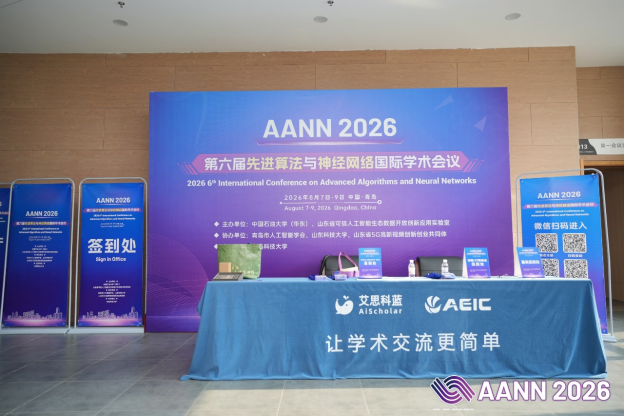
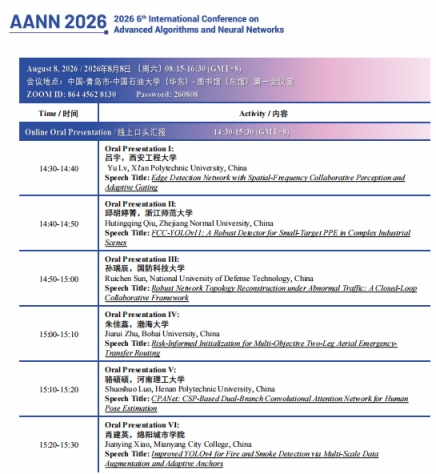
Qingdao, August 8, 2026 — The 6th International Conference on Advanced Algorithms and Neural Networks (AANN 2026) held online oral presentations in Qingdao, China. Jianying Xiao and his research group from the School of Artificial Intelligence, Mianyang City College delivered an academic oral speech titled Improved YOLOv4 for Fire and Smoke Detection via Multi-Scale Data Augmentation and Adaptive Anchors, exchanging innovative optimization schemes for intelligent early fire monitoring with scholars worldwide.
Conventional physical fire detectors have obvious defects including delayed response, monitoring blind zones and frequent false alarms. Meanwhile, the original YOLOv4 model cannot adapt well to fire and smoke detection tasks, restricted by data distribution deviation, mismatched default anchor boxes and inadequate bounding box regression loss. To solve these practical problems, the team put forward three collaborative improvement strategies, among which segmented cosine-transition hybrid data augmentation serves as the core original contribution. Unlike YOLOX’s abrupt shutdown of strong augmentation at a fixed epoch, the proposed cosine decay window from epoch 210 to 230 avoids sharp loss surges and realizes smooth matching between synthetic augmented images and real surveillance scene data. Two auxiliary optimization modules are also integrated: K-means++ self-clustered adaptive anchors for tiny remote fire sources, and CIoU loss to fit irregular, transparent smoke shapes.
All experiments were conducted on a self-established dataset containing 23,244 fire and smoke surveillance images. The improved model achieves 76.16% mAP@0.5, rising by 7.62% compared with the baseline YOLOv4, with 81.86% AP for flame targets and 70.46% AP for smoke targets. It supports stable real-time detection at 30 FPS, surpassing mainstream lightweight YOLO variants in overall accuracy and striking a superior accuracy-speed trade-off against transformer-based RT-DETR-l. Ablation experiments prove the segmented augmentation strategy brings the maximum independent performance promotion of 3.26%.
In the post-report communication session, experts from Malaysia, South Korea and many Chinese universities discussed small-target recognition and edge device deployment with the team. The research team analyzed the core difficulty of smoke identification brought by translucent, shapeless smoke features, and illustrated three follow-up research directions: introducing optical flow spatio-temporal features, lightweight model compression, and multi-modal fusion of infrared and visible light for all-weather fire detection.
This conference participation realizes high-level international academic communication for the School of Artificial Intelligence. The team will further expand real-scene monitoring datasets, develop embedded intelligent fire alarm system prototypes, and apply for special research funds to accelerate the industrial landing of visual fire detection algorithms.